<?xml version="1.0" encoding="utf-8"?><?xml-stylesheet type="text/xsl" href="atom.xsl"?>
<feed xmlns="http://www.w3.org/2005/Atom">
    <id>https://water.juliet.coffee/blog</id>
    <title>JCWS Field Notes</title>
    <updated>2026-04-30T00:00:00.000Z</updated>
    <generator>https://github.com/jpmonette/feed</generator>
    <link rel="alternate" href="https://water.juliet.coffee/blog"/>
    <subtitle>Build journal and design notes from the Juliet Coffee Water System project.</subtitle>
    <icon>https://water.juliet.coffee/img/favicon.ico</icon>
    <rights>Copyright © 2026 Juliet Coffee.</rights>
    <entry>
        <title type="html"><![CDATA[Why I Bought a Hoffman PLC Enclosure]]></title>
        <id>https://water.juliet.coffee/blog/hoffman-control-box-enclosure</id>
        <link href="https://water.juliet.coffee/blog/hoffman-control-box-enclosure"/>
        <updated>2026-04-30T00:00:00.000Z</updated>
        <summary type="html"><![CDATA[The JCWS brain needs a home. NEMA and IP ratings, sizing for heat, and how I bought a $2,000 Hoffman box used for $350.]]></summary>
        <content type="html"><![CDATA[<p>The Juliet Coffee Water System (JCWS) needs a brain.  You can't just have all those pumps and filters and tanks doing their own thing whenever they want; you'd end up with puddles and pools of the kind of water you wouldn't feed to a stray opossum.</p>
<p>That "brain" to control everything is called a <code>PLC</code>, or Programmable Logic Controller, and like all brains, it needs protection.</p>
<!-- -->
<p>Now, before my nerd friends tell me that I could have done this whole thing with a Raspberry Pi or a RAK Wisblock for $35, I'll say it: You'd be right for a janky setup at your house that's brittle and only fixable and manageable by you.</p>
<p>However, for a busy coffee shop with baristas and staff who aren't nerd-native, you'd be wrong.  You need something robust, well understood, well documented, and bombproof.  You need a PLC.</p>
<p>I'll get into the PLC array (brain, component trays, line reactors, VFDs, and the rest of it) in another article, but today I wanted to talk about something way more basic:  The box it lives in.</p>
<p>That box is called an <code>enclosure</code> (sometimes <code>cabinet</code>).  All of the different components get mounted on a metal plate attached to the inside back of the box.  This metal plate is called a <code>subpanel</code>, <code>back panel</code> or sometimes <code>sub-plate</code>.</p>
<div class="theme-admonition theme-admonition-note admonition_IZjC alert alert--secondary"><div class="admonitionHeading_uVvU"><span class="admonitionIcon_HiR3"><svg viewBox="0 0 14 16"><path fill-rule="evenodd" d="M6.3 5.69a.942.942 0 0 1-.28-.7c0-.28.09-.52.28-.7.19-.18.42-.28.7-.28.28 0 .52.09.7.28.18.19.28.42.28.7 0 .28-.09.52-.28.7a1 1 0 0 1-.7.3c-.28 0-.52-.11-.7-.3zM8 7.99c-.02-.25-.11-.48-.31-.69-.2-.19-.42-.3-.69-.31H6c-.27.02-.48.13-.69.31-.2.2-.3.44-.31.69h1v3c.02.27.11.5.31.69.2.2.42.31.69.31h1c.27 0 .48-.11.69-.31.2-.19.3-.42.31-.69H8V7.98v.01zM7 2.3c-3.14 0-5.7 2.54-5.7 5.68 0 3.14 2.56 5.7 5.7 5.7s5.7-2.55 5.7-5.7c0-3.15-2.56-5.69-5.7-5.69v.01zM7 .98c3.86 0 7 3.14 7 7s-3.14 7-7 7-7-3.12-7-7 3.14-7 7-7z"></path></svg></span>note</div><div class="admonitionContent_bl22"><p>Nerd alert! You'll also hear that back panel called a <code>backplane</code>, though technically that's the electronic communication bus where PLC modules are seated.</p></div></div>
<p>The whole thing together (enclosure + subpanel + components + wiring) is called the <code>control panel</code>.</p>
<h2 class="anchor anchorTargetStickyNavbar_SAay" id="who-makes-the-best-plc-enclosures">Who Makes The Best PLC Enclosures?<a href="https://water.juliet.coffee/blog/hoffman-control-box-enclosure#who-makes-the-best-plc-enclosures" class="hash-link" aria-label="Direct link to Who Makes The Best PLC Enclosures?" title="Direct link to Who Makes The Best PLC Enclosures?" translate="no">​</a></h2>
<p>The top of the manufacturing market for enclosures is a company called <a href="https://www.nvent.com/en-us/hoffman" target="_blank" rel="noopener noreferrer" class="">nVent Hoffman</a>.</p>
<p>Confusingly, the enclosures are usually called "Hoffman boxes" but the company that actually sells them is <code>nVent Electric</code>, and Hoffman is one of their brands.</p>
<h3 class="anchor anchorTargetStickyNavbar_SAay" id="hoffman-vs-saginaw-vs-rittal">Hoffman vs Saginaw vs Rittal<a href="https://water.juliet.coffee/blog/hoffman-control-box-enclosure#hoffman-vs-saginaw-vs-rittal" class="hash-link" aria-label="Direct link to Hoffman vs Saginaw vs Rittal" title="Direct link to Hoffman vs Saginaw vs Rittal" translate="no">​</a></h3>
<p>There are other excellent enclosure manufacturers out there including Saginaw and Rittal.</p>
<table><thead><tr><th>Brand</th><th>Reputation</th><th>Where you find it</th><th>Price posture</th></tr></thead><tbody><tr><td>nVent Hoffman</td><td>The default spec</td><td>Graybar, Rexel, AutomationDirect, eBay</td><td>Premium</td></tr><tr><td>Saginaw (SCE)</td><td>Workhorse alternative</td><td>AutomationDirect, Trimantec</td><td>20–40% less than Hoffman new</td></tr><tr><td>Rittal</td><td>European, modular systems</td><td>Industrial distributors</td><td>Premium, strong on free-standing</td></tr></tbody></table>
<p>Really, you won't go wrong with any of 'em, and for most of us buying our first (or tenth) PLC enclosure, choosing between brands is a much lower priority than choosing the right size.</p>
<p>The only time that brand becomes important is if you go into production and need a reliable supply of the same box every time.  In that case, pick a brand and stick with it.  Everyone who's anyone will recognize a Hoffman box, but also...nobody cares.</p>
<h3 class="anchor anchorTargetStickyNavbar_SAay" id="why-i-picked-hoffman-over-the-alternatives">Why I picked Hoffman over the alternatives<a href="https://water.juliet.coffee/blog/hoffman-control-box-enclosure#why-i-picked-hoffman-over-the-alternatives" class="hash-link" aria-label="Direct link to Why I picked Hoffman over the alternatives" title="Direct link to Why I picked Hoffman over the alternatives" translate="no">​</a></h3>
<p>Here's why I picked Hoffman.</p>
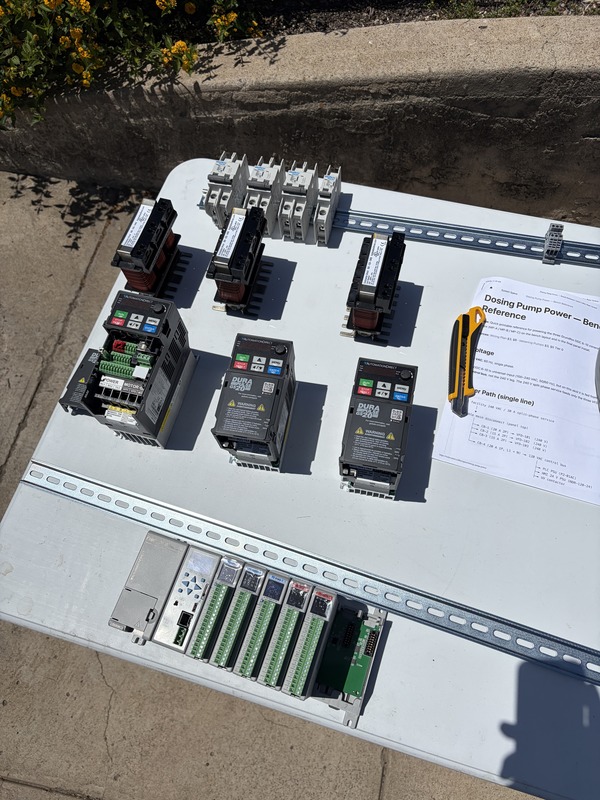
<p>I first heard about Hoffman boxes when Pete &amp; I laid out the first order from Automation Direct on a folding table in my driveway.</p>
<figure><img src="https://media.juliet.coffee/blog/choosing-hoffman-box/first-layout-of-plc-enclosure-components.jpg" alt="Laying out AutomationDirect components for the PLC: Line reactors, VFDs, circuit breakers, and a DIN rail" loading="lazy"><figcaption>Rough first layout to get an idea of what we have and how much space we'll need in the PLC enclosure.</figcaption></figure>
<p>I'd had experience with putting up outdoor enclosures for remote LoRaWAN gateways backhauling via cell, so the idea of an enclosure wasn't new to me.</p>
<p>I've bought enclosures from Allied Moulded $250 boxes down to $18 Amazon specials.  They all worked well enough for what I needed then, which was a box that kept out the rain and the weather, didn't get too hot, and protected the guts of a fairly simple system (Raspberry Pi controller, modem, battery, inverter, and sometimes, small fans.)</p>
<p>However, I was lacking in experience in two places.  None of those boxes had to pass code checks, and no one really cared what those looked like.  They were all off on a mountain somewhere, and the sole goal was performance.</p>
<p>For JCWS, there are additional parameters to meet.  This has to pass a code inspection, and because it's customer facing, it has to look good.  Now, looks are subjective but passing code isn't, which brings us to our first point of discussion.</p>
<h2 class="anchor anchorTargetStickyNavbar_SAay" id="nema-and-ip-ratings">NEMA and IP Ratings<a href="https://water.juliet.coffee/blog/hoffman-control-box-enclosure#nema-and-ip-ratings" class="hash-link" aria-label="Direct link to NEMA and IP Ratings" title="Direct link to NEMA and IP Ratings" translate="no">​</a></h2>
<p>Every (legit) enclosure you buy will have a NEMA (National Electrical Manufacturers Association) code and an IP (Ingress Protection / International Protection) rating.  Both ratings refer to standards for protection from outside forces, from fingers to freezing rain.</p>
<h3 class="anchor anchorTargetStickyNavbar_SAay" id="nema">NEMA<a href="https://water.juliet.coffee/blog/hoffman-control-box-enclosure#nema" class="hash-link" aria-label="Direct link to NEMA" title="Direct link to NEMA" translate="no">​</a></h3>
<p>NEMA ratings define standards for the ability to protect against dust, water, ice, and corrosion.  For example, NEMA 1 is for indoors, NEMA 3R is for outdoors, and NEMA 4X is for corrosion resistance.</p>
<h3 class="anchor anchorTargetStickyNavbar_SAay" id="ip">IP<a href="https://water.juliet.coffee/blog/hoffman-control-box-enclosure#ip" class="hash-link" aria-label="Direct link to IP" title="Direct link to IP" translate="no">​</a></h3>
<p>IP ratings are "IP" followed by 2 digits.  The first digit (0-6) refers to the protection against solid objects like dust, fingers, etc.  The second digit (0-9) refers to protection against liquids like water.  The higher the number, the better the protection.</p>
<div class="theme-admonition theme-admonition-info admonition_IZjC alert alert--info"><div class="admonitionHeading_uVvU"><span class="admonitionIcon_HiR3"><svg viewBox="0 0 14 16"><path fill-rule="evenodd" d="M7 2.3c3.14 0 5.7 2.56 5.7 5.7s-2.56 5.7-5.7 5.7A5.71 5.71 0 0 1 1.3 8c0-3.14 2.56-5.7 5.7-5.7zM7 1C3.14 1 0 4.14 0 8s3.14 7 7 7 7-3.14 7-7-3.14-7-7-7zm1 3H6v5h2V4zm0 6H6v2h2v-2z"></path></svg></span>info</div><div class="admonitionContent_bl22"><p>If you see an "X" in the number on an IP rating, it means it hasn't been tested for that factor.</p></div></div>
<p>What I needed on the NEMA side is at least a 1 (indoor), and on IP side is at least IP 54. IP 54 is dust-protected with limited splash resistance.</p>
<p>That matches how this enclosure actually lives inside our dessert shop in full view of customers. Nobody will hose down the cabinet, but closing-shift wipe-downs can splash sanitizer; we're better off being protected.</p>
<p>The Hoffman CSD362410 I ended up with carries NEMA/EEMAC Type 4, 12, and 13 ratings as well as an IP66 rating. NEMA 4 is windblown dust and rain, splashing water, and hose-directed water along with remaining undamanged by the formation of ice on the enclosure.  Not going to happen in San Diego; we have perfect weather 340 days a year.</p>
<p>NEMA 12 &amp; 13 means it's designed for indoor use to protect against lint, dust, fly-ins and dripping non-corrosive liquids like oil or coolants.</p>
<p>IP66 is dust-tight and protected against powerful water jets from any direction.</p>
<p>It's UL 508A listed, and cUL listed as well.</p>
<p>I kind of like overkill, but that's just me, and it can be an expensive habit.</p>
<h2 class="anchor anchorTargetStickyNavbar_SAay" id="what-material-should-your-hoffman-box-be">What Material Should Your Hoffman Box Be?<a href="https://water.juliet.coffee/blog/hoffman-control-box-enclosure#what-material-should-your-hoffman-box-be" class="hash-link" aria-label="Direct link to What Material Should Your Hoffman Box Be?" title="Direct link to What Material Should Your Hoffman Box Be?" translate="no">​</a></h2>
<p>In the same realm as far as protection from the elements is the material you choose. For indoor dry use like mine, painted mild steel is fine.</p>
<p>If you're putting this in a washdown or food prep environment look at 304 stainless.  For chemical/marine applications, 316 SS is more likely to be what you need, and if your environment has corrosive but non-conductive needs, check out fiberglass.</p>
<h2 class="anchor anchorTargetStickyNavbar_SAay" id="how-much-does-a-hoffman-box-cost">How Much Does A Hoffman Box Cost?<a href="https://water.juliet.coffee/blog/hoffman-control-box-enclosure#how-much-does-a-hoffman-box-cost" class="hash-link" aria-label="Direct link to How Much Does A Hoffman Box Cost?" title="Direct link to How Much Does A Hoffman Box Cost?" translate="no">​</a></h2>
<p>When it comes to buying a box, you can buy exactly what you want from nVent or any of their distributors (like <a href="https://www.gordonelectricsupply.com/p/Hoffman-Csd362410-Wall-Mount-Encl/6790428?" target="_blank" rel="noopener noreferrer" class="">Gordon Electric Supply, here</a>), but Hoffman ain't known for being the cheapest box on the market.</p>
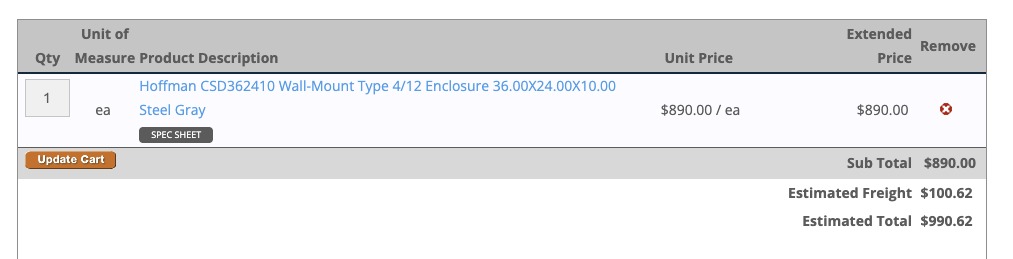
<p>For the "Made in the USA" CSD362410 I bought, when I did a quick internet search and included shipping and tax, the landed cost was just under $1,000 before tax.</p>
<figure><img src="https://media.juliet.coffee/blog/choosing-hoffman-box/hoffman-362410-online-pricing.jpg" alt="Online pricing for a Hoffman CSD362410 PLC enclosure showing $890 base price plus estimated freight" loading="lazy"><figcaption>Pricing a Hoffman CSD362410 box online at $890 plus $100 freight estimated (will probably be more) plus tax.</figcaption></figure>
<p>The freight, by the way, is estimated.  I've gotten half a dozen quotes in the last week for boxes from all over America shipped to San Diego, and the cheapest I've seen is $250.  I'm guessing that <code>$100</code> for freight is if you live next door.</p>
<p>The secondary market is decent, so it's reasonable to hunt on eBay until you find something for about 50% of the cost of new.</p>
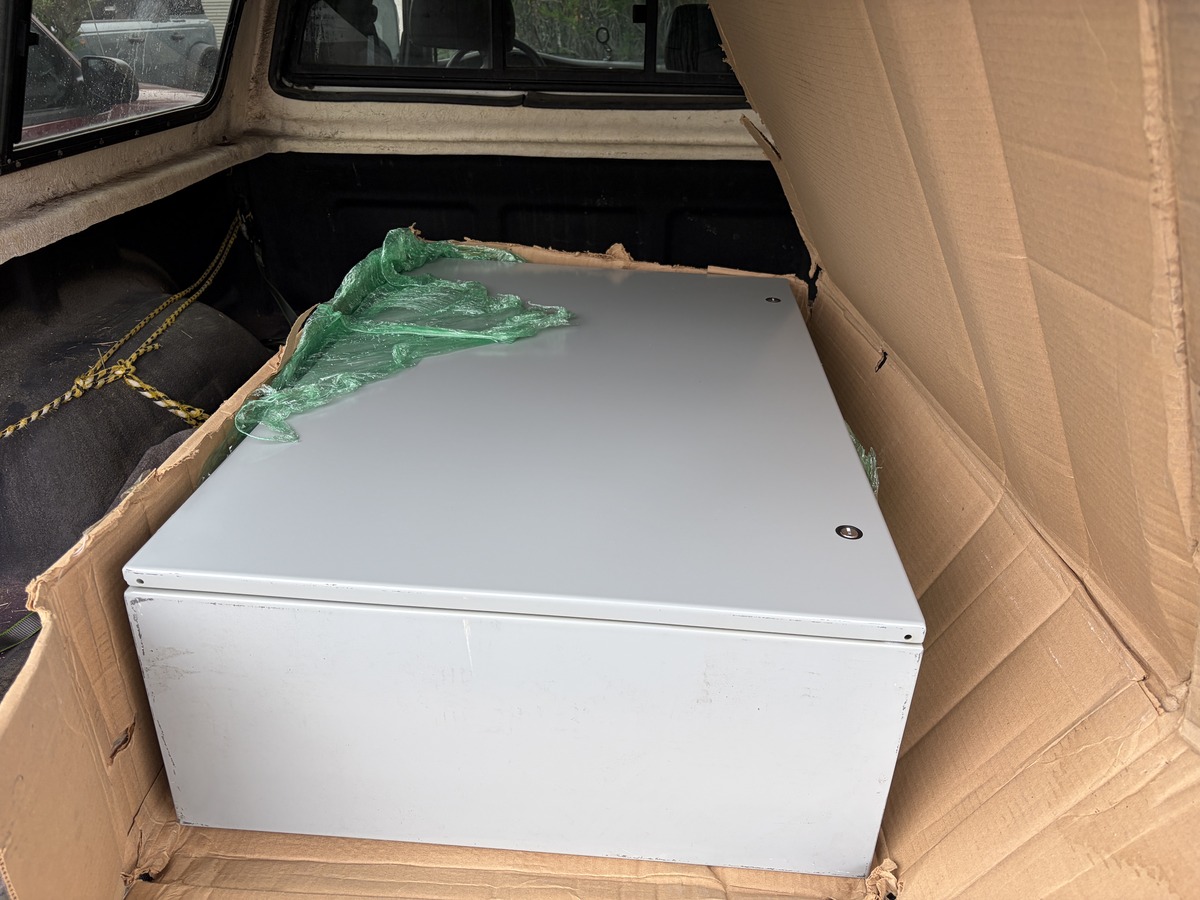
<p>In my case, an electrical contractor in Chino was selling a 36 x 24 x 10 box for $450.  On Tuesday I offered $350 and pickup, and by Friday I had the box in hand and safely back in the shop for another $75 in gas.</p>
<figure><img src="https://media.juliet.coffee/blog/choosing-hoffman-box/hoffman-box-in-back-of-truck.jpg" alt="Hoffman box in the back of my Tacoma after picking up an eBay deal" loading="lazy"><figcaption>Here's my eBay gold:  A new, open box Hoffman CSD362410 36 x 24 x 10.</figcaption></figure>
<p>For my purposes that's fine, but you may have different requirements.  Obviously, if you're installing a Hoffman box on the side of a nuclear sub going through decon, you'll prolly want higher NEMA/IP ratings.</p>
<p>Those may not be the right reasons for you, but that's why I bought what I bought.</p>
<h2 class="anchor anchorTargetStickyNavbar_SAay" id="how-to-size-a-plc-control-panel-enclosure">How To Size A PLC Control Panel Enclosure<a href="https://water.juliet.coffee/blog/hoffman-control-box-enclosure#how-to-size-a-plc-control-panel-enclosure" class="hash-link" aria-label="Direct link to How To Size A PLC Control Panel Enclosure" title="Direct link to How To Size A PLC Control Panel Enclosure" translate="no">​</a></h2>
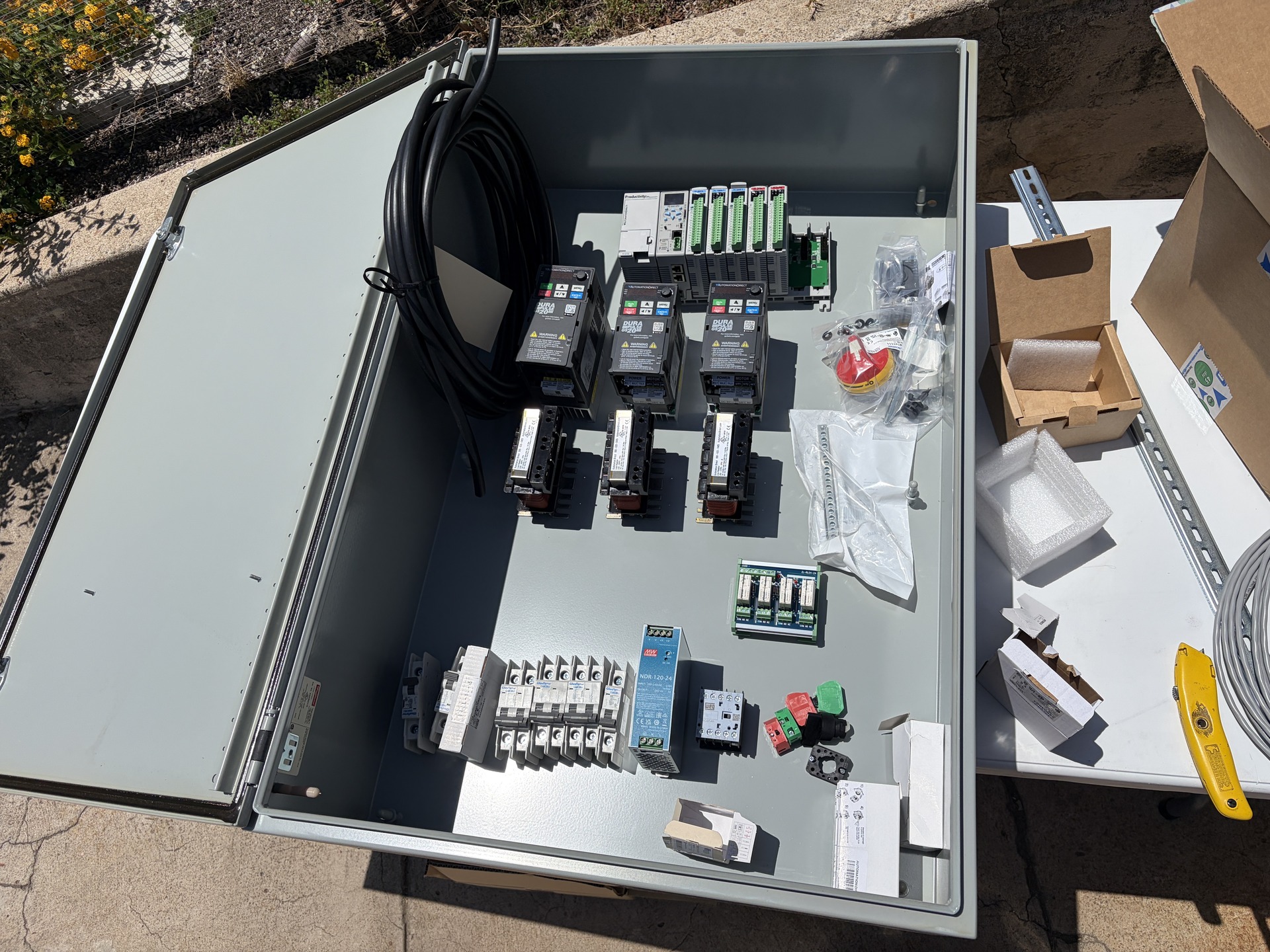
<p>I skipped over how I got to the dimensions, but it's pretty straightforward. Lay out everything you're using for the PLC, organize it in rows that'll mount on DIN rails, then measure it and give yourself plenty of finger-working space.  Here's I am just putting everything in to get an idea of how much space I have to work with.</p>
<figure><img src="https://media.juliet.coffee/blog/choosing-hoffman-box/rough-internal-layout-hoffman-box-plc.jpg" alt="Rough layout of PLC components in a Hoffman box to start organizing the final layout" loading="lazy"><figcaption>Rough component layout inside the Hoffman CSD362410 PLC enclosure before final DIN rail, wire duct, and cooling layout.</figcaption></figure>
<p>Oh, and measure for heat. "Heat", you ask?</p>
<h3 class="anchor anchorTargetStickyNavbar_SAay" id="heat-in-a-plc-enclosure">Heat In A PLC Enclosure<a href="https://water.juliet.coffee/blog/hoffman-control-box-enclosure#heat-in-a-plc-enclosure" class="hash-link" aria-label="Direct link to Heat In A PLC Enclosure" title="Direct link to Heat In A PLC Enclosure" translate="no">​</a></h3>
<p>You need to consider the thermal load, asking two questions: What'll the external environment be like, and what are your components rated to?</p>
<p>For our San Diego dessert shop where we rely on natural ventilation and have a bunch of freezers pumping heat into the room, we're looking at temps as high as the 90s during the summer and down into the 50s during winter nights.  Ah yes, the bitter depths of winter.</p>
<p>You don't want to cook your components; they're expensive to replace, and line reactors do NOT taste like chicken.</p>
<p>The AutomationDirect stack I'm using (from PLC to 11-slot tray to breakers to line reactors) doesn't have a consistent temperature limit.  The HMI is rated to about +50 °C, the Productivity2000 family and GS20-class VFDs are generally +50–60 °C depending on part and derating — but the Gladiator miniature breakers are only +40 °C (104 °F).</p>
<p>That breaker limit drives our cooling choice, not the rest of the PLC.</p>
<h3 class="anchor anchorTargetStickyNavbar_SAay" id="making-thermal-load-calcs">Making Thermal Load Calcs<a href="https://water.juliet.coffee/blog/hoffman-control-box-enclosure#making-thermal-load-calcs" class="hash-link" aria-label="Direct link to Making Thermal Load Calcs" title="Direct link to Making Thermal Load Calcs" translate="no">​</a></h3>
<p>Here's what you need to do: Add up watt-loss from everything on the subpanel (VFDs dominate), estimate how much heat the steel box can dump to the room at worst-case indoor ambient, and see what's left to move with air.</p>
<p>For the Hoffman CSD362410 I chose (36" × 24" × 10"), the internal dissipation lands near ~200 W and enclosure surface area near ~18.7 ft².</p>
<p>With hot-shop summer air in the ~90 °F / 32 °C range, I'm looking at a few hundred BTU/hr that still needs helping along after conduction through the walls.  If ambient gets into the ~35–40 °C / 95–104 °F zone, the steel walls ain't up to the job and we're closer to moving the full ~200 W through airflow.</p>
<p>That means we'll use a filtered intake fan plus filtered exhaust in about the 100–150 CFM class.</p>
<p>I'll run it on a thermostat in the ~95–100 °F internal range so the fan isn't always screaming: 95 °F (~35 °C) inside is still safely under the +40 °C Gladiator cap, with margin for uneven hot spots near the drives.</p>
<p>:::info Update — May 2026</p>
<p>When I actually pulled the trigger on the cooling parts I went four 120 mm fans, not one-in / one-out: <strong>2× Noctua NF-A12x25 intake low + 2× exhaust high</strong> for diagonal airflow, with <strong>ZYAMY magnetic dust filters</strong> on the intakes and <strong>Noctua NA-FG1-12 SX5</strong> wire grills on the inside face of every fan. Each Noctua only moves ~35 CFM free-air and the intake filters derate that further, so two fans wouldn't have held the box on a hot day — four gives me filter-loading margin.</p>
<p>Power: a <strong>Mean Well DDR-15G-12</strong> DIN-rail converter steps the panel 24 V bus down to 12 V for the fans. Control: <strong>two-stage on/off</strong> on the second P2-08TRS relay module — stage 1 (~95 °F) runs one intake/exhaust pair, stage 2 (~105 °F) brings the other pair in, with deadbands on the off-transitions to stop the relays chattering. Temperature is read by a <strong>generic PT100 RTD</strong> on the spare channel 2 of the P2-06RTD module.</p>
<p>The four 4″ cutouts drop the as-shipped NEMA 4 / 12 / 13 rating down to about <strong>NEMA 12 / IP54</strong> — dust-protected and splash-resistant, but no longer hose-down. That's still fine for the dessert shop, but I wouldn't make this trade for a washdown environment.</p>
<p>Full design now lives in <a class="" href="https://water.juliet.coffee/specs/system-overview#57-enclosure-thermal-management">system overview §5.7</a> and <a class="" href="https://water.juliet.coffee/guides/wiring-plan#14-enclosure-cooling-system">wiring plan §14</a>; landed in <strong><a class="" href="https://water.juliet.coffee/specs/bom">BOM Rev N</a> / RO-SPEC-001 Rev K / WIRE-001 Rev D</strong>.</p>
<p>:::</p>
<h2 class="anchor anchorTargetStickyNavbar_SAay" id="thats-the-box">That's the box<a href="https://water.juliet.coffee/blog/hoffman-control-box-enclosure#thats-the-box" class="hash-link" aria-label="Direct link to That's the box" title="Direct link to That's the box" translate="no">​</a></h2>
<p>That's as much as I know right now about buying a PLC box. If you found this useful, go be awesome to someone. If you need help building your own world-class water system, <a class="" href="https://water.juliet.coffee/contact">drop me a line</a>.</p>]]></content>
        <author>
            <name>Nik Hawks</name>
            <uri>https://nikhawks.com</uri>
        </author>
        <category label="Procurement" term="Procurement"/>
    </entry>
    <entry>
        <title type="html"><![CDATA[A Day In The Life Of Sourcing Pumps]]></title>
        <id>https://water.juliet.coffee/blog/finding-the-third-pump</id>
        <link href="https://water.juliet.coffee/blog/finding-the-third-pump"/>
        <updated>2026-04-27T00:00:00.000Z</updated>
        <summary type="html"><![CDATA[Finding new pumps that match your specs is easy, but expensive. Finding a pump on the secondary market takes a little more searching.]]></summary>
        <content type="html"><![CDATA[<p>The JWCS needs 3 pumps; one to push water across the RO membrane, one to move water from the permeate tank (clean RO produced water) to the treated tank (where the minerals have been dosed in), and one to push water to the coffee machine.</p>
<p>The first two were found and bought in the first two weeks, but the third one took a little longer to find.</p>
<p>It's not that the third pump was hard to find, it's just that the pumps I need don't come on the market super often, so I just had to be patient.</p>
<p>As <a class="" href="https://water.juliet.coffee/#philosophy">I've said before</a>, the idea of taking what was once a really expensive, highly engineered piece of kit and using it in a system that could never really justify buying new, but could greatly benefit from industrial-level reliability and performance, is kind of a fetish of mine.</p>
<p>I've done it with everything from high-altitude thermal vacuum chambers to <a href="https://sled.wtf/" target="_blank" rel="noopener noreferrer" class="">the alternator on a Lexus for an exercise sled</a>; I LOVE using badass rugged older gear in new projects.</p>
<!-- -->
<p>The first step is to figure out what you actually need.  In my case, the core requirement for the <a href="https://docs.juliet.coffee/reference/cafe-racer" target="_blank" rel="noopener noreferrer" class="">SanRemo Cafe Racer</a> is supply between 29 and 65 psi and NSF 61.</p>
<p>Secondary to that was fitting in with the other pumps and having interchangeable parts where possible, so I knew I wanted a Grundfos.</p>
<p>That left me with looking for a pump in the CRN1S lineup, with anywhere from 5 to 10 stages, where each stage adds anywhere from 10-20 psi.</p>
<p>I had a few more restrictions, mostly from earlier decisions like circuit breaker/line reactor/VFD sizing.  I knew I didn't need a huge pump (hell, this is overspec'd as is), and on the electrical side I'd sized for 0.5hp or lower.</p>
<div class="theme-admonition theme-admonition-note admonition_IZjC alert alert--secondary"><div class="admonitionHeading_uVvU"><span class="admonitionIcon_HiR3"><svg viewBox="0 0 14 16"><path fill-rule="evenodd" d="M6.3 5.69a.942.942 0 0 1-.28-.7c0-.28.09-.52.28-.7.19-.18.42-.28.7-.28.28 0 .52.09.7.28.18.19.28.42.28.7 0 .28-.09.52-.28.7a1 1 0 0 1-.7.3c-.28 0-.52-.11-.7-.3zM8 7.99c-.02-.25-.11-.48-.31-.69-.2-.19-.42-.3-.69-.31H6c-.27.02-.48.13-.69.31-.2.2-.3.44-.31.69h1v3c.02.27.11.5.31.69.2.2.42.31.69.31h1c.27 0 .48-.11.69-.31.2-.19.3-.42.31-.69H8V7.98v.01zM7 2.3c-3.14 0-5.7 2.54-5.7 5.68 0 3.14 2.56 5.7 5.7 5.7s5.7-2.55 5.7-5.7c0-3.15-2.56-5.69-5.7-5.69v.01zM7 .98c3.86 0 7 3.14 7 7s-3.14 7-7 7-7-3.12-7-7 3.14-7 7-7z"></path></svg></span>note</div><div class="admonitionContent_bl22"><p>What you and I might call a "pump" is, in industrial purchasing, actually a pump and a motor.  The pump is the framework for moving the water, and the motor drives the pump.  Everything has to match up in order for the unit to be useable.</p></div></div>
<p>The pump motor also had to be 60 Hz (obvi, using this in the US), 230V and 3 phase so we could control it with the VFD.</p>
<p>So there's our spec, which I wrote up into a `distribution-pump-spec.md' doc and fed it into a custom tool I built called 'ebay-finder' that helps me narrow down what I'm looking for.</p>
<p>I've dropped the actual doc in at the bottom so you can see what that looks like.</p>
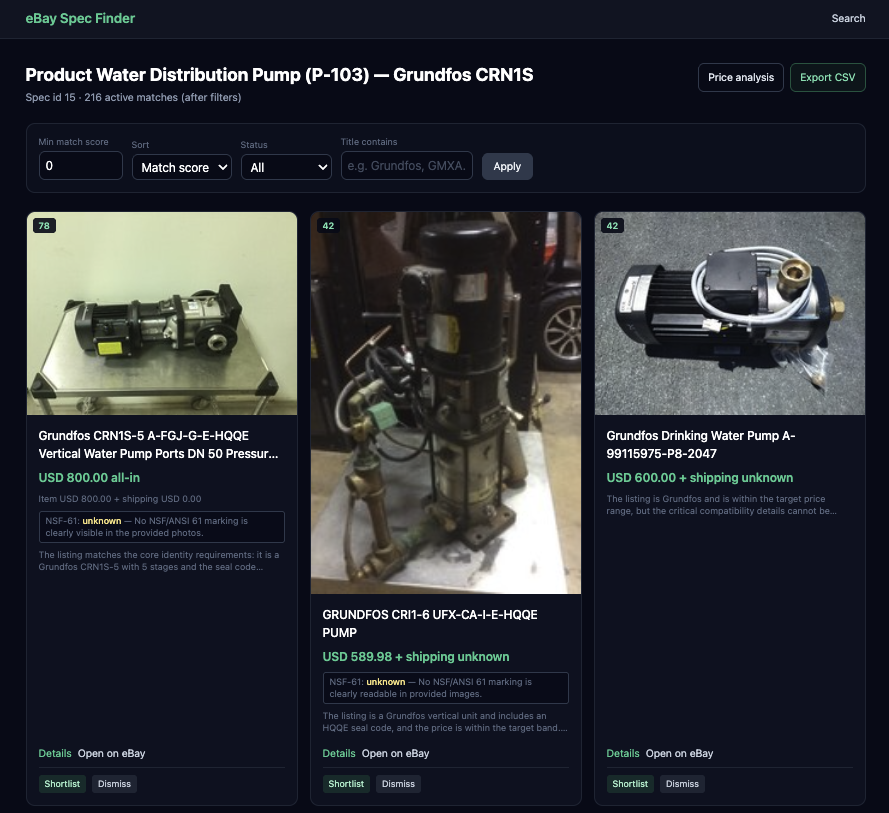
<p>The tool returned 216 active matches, though only one scored higher than 60, which is usually what I look for.  It missed the <code>NSF61</code> plate, so when I opened that top listing (scoring 78), and saw it, then verified the rest of the pump's stats, I put in an offer.</p>
<p>Top 3 search results:</p>
<figure><img src="https://media.juliet.coffee/blog/finding-the-third-pump/ebay-distribution-spec-search.png" alt="ebay-finder web app showing 216 active matches for the P-103 distribution-pump search. The top match — Grundfos CRN1S-5 A-FGJ-G-E-HQQE at $800 all-in — scores 78. The next two listings (a CRI1-6 at $589.98 and a Grundfos drinking-water pump at $600) both score 42." loading="lazy"><figcaption>The ebay-finder tool returned 216 active matches but only one scored above the 60-point threshold I usually require — the leftmost listing at score 78.</figcaption></figure>
<p>I opened the number one listing (scoring at 78, which is excellent), verified that the ebay-finder tool had missed the NSF61 marking, and submitted an offer.</p>
<p>The next day I woke up to a purchased pump.  What did I buy?</p>
<p>Grundfos uses an alphanumeric system to tell you what you're getting with their pumps, in this case:</p>
<div class="language-text codeBlockContainer_ZGJx theme-code-block" style="--prism-color:#393A34;--prism-background-color:#f6f8fa"><div class="codeBlockContent_kX1v"><pre tabindex="0" class="prism-code language-text codeBlock_TAPP thin-scrollbar" style="color:#393A34;background-color:#f6f8fa"><code class="codeBlockLines_AdAo"><div class="token-line" style="color:#393A34"><span class="token plain">CRN1S-5 A-FGJ-G-E-HQQE</span><br></div><div class="token-line" style="color:#393A34"><span class="token plain" style="display:inline-block"></span><br></div><div class="token-line" style="color:#393A34"><span class="token plain">CRN1S-5           A     FGJ         G        E             HQQE</span><br></div><div class="token-line" style="color:#393A34"><span class="token plain">└────┬─┘          │     └┬┘         │        │             └┬─┘</span><br></div><div class="token-line" style="color:#393A34"><span class="token plain">  family stages   │      │          │        │              │ </span><br></div><div class="token-line" style="color:#393A34"><span class="token plain">               version   │          │        │              │</span><br></div><div class="token-line" style="color:#393A34"><span class="token plain">                       connection   │        │              │ </span><br></div><div class="token-line" style="color:#393A34"><span class="token plain">                                  material   │              │</span><br></div><div class="token-line" style="color:#393A34"><span class="token plain">                                          o-ring elastomer  │</span><br></div><div class="token-line" style="color:#393A34"><span class="token plain">                                                        shaft seal</span><br></div></code></pre></div></div>
<ul>
<li class="">CRN1S: The family of pumps with (relatively) low flow and a stainless steel base</li>
<li class="">5: 5 stages (the number of impellers)</li>
<li class="">FGJ: <code>Flange/G (DIN-ANSI-JIS)</code> a combined connection allowing the pump to be bolted to various international piping standards</li>
<li class="">G: <code>316L stainless steel</code>, a material upgrade</li>
<li class="">E: <code>EPDM</code>, standard for water applications and compatible with the E in the HQQE seal</li>
<li class="">HQQE - H = balanced cartridge, QQ = silicon carbide/silicon carbide faces, E = EPDM secondary seal.</li>
</ul>
<p>This will easily provide what the SanRemo needs and more.  At 3 gallons per minute it pushes ~110 feet of Total Dynamic Head, or about <code>~47 psi</code>.</p>
<p>Now, any coffee machine geek knows that no coffee machine out there will use 3 gpm or anything close.  Running a 3 group wide open and the hot water tap running will cost you well under 0.5 gpm.</p>
<p>So why use this pump?  Stability.  Industrial pumps are rated at higher flow rates than some $100 Amazon pump.  This means when the Racer <em>does</em> demand any amount of water, the pressure doesn't sag.  In fact, running the pump to deliver 47 psi is running it in its lazy zone; this thing is loafing even when the cafe's banging.</p>
<p>The bigger picture here for the Paleo Treats coffee experience is to deliver superb coffee effortlessly and fast.  THAT'S why I'm overspec'ing these pumps.</p>
<p>Now, under $800 for this pump seems like a good deal, however... Since this is a custom skid and we're not ordering new from the factory (at something like $3k for a new pump vs the ~$730 I paid), I also have to factor in the costs for adapting from the 1" ports.</p>
<p>Assume that'll be another $200 or so, and I'll still have gotten a ripping deal on a monster that doesn't break a sweat when the line is 10 deep and they only ask for more, more, more...</p>
<p>As I was taught many many moons, ago:  <code>Proper prior preparation prevents piss poor performance</code></p>
<p>Be prepared!</p>
<h2 class="anchor anchorTargetStickyNavbar_SAay" id="distribution-pump-spec-doc">Distribution Pump Spec Doc<a href="https://water.juliet.coffee/blog/finding-the-third-pump#distribution-pump-spec-doc" class="hash-link" aria-label="Direct link to Distribution Pump Spec Doc" title="Direct link to Distribution Pump Spec Doc" translate="no">​</a></h2>
<div class="language-# codeBlockContainer_ZGJx theme-code-block" style="--prism-color:#393A34;--prism-background-color:#f6f8fa"><div class="codeBlockContent_kX1v"><pre tabindex="0" class="prism-code language-# codeBlock_TAPP thin-scrollbar" style="color:#393A34;background-color:#f6f8fa"><code class="codeBlockLines_AdAo"><div class="token-line" style="color:#393A34"><span class="token plain" style="display:inline-block"></span><br></div><div class="token-line" style="color:#393A34"><span class="token plain">Distribution pump for the water skid: T-102 → espresso machine + drinking water station. Driven by an existing VFD-103 (½ HP, 3-φ 230 V output, 60 Hz).</span><br></div><div class="token-line" style="color:#393A34"><span class="token plain" style="display:inline-block"></span><br></div><div class="token-line" style="color:#393A34"><span class="token plain">## 1. Pump</span><br></div><div class="token-line" style="color:#393A34"><span class="token plain" style="display:inline-block"></span><br></div><div class="token-line" style="color:#393A34"><span class="token plain">- **Grundfos CRN1S** [CRITICAL]</span><br></div><div class="token-line" style="color:#393A34"><span class="token plain">  - Reject any other brand</span><br></div><div class="token-line" style="color:#393A34"><span class="token plain">  - Reject any other Grundfos family: plain `CR` (cast iron), `CRI`, `CRT`, `CRNE` / `CRIE` / `CRE` (built-in VFD)</span><br></div><div class="token-line" style="color:#393A34"><span class="token plain" style="display:inline-block"></span><br></div><div class="token-line" style="color:#393A34"><span class="token plain" style="display:inline-block"></span><br></div><div class="token-line" style="color:#393A34"><span class="token plain">- **Stages: 5 to 10** [CRITICAL]</span><br></div><div class="token-line" style="color:#393A34"><span class="token plain">  - Duty: 30 psi @ 3 gpm = ~70 ft TDH. CRN1S-5 delivers ~110 ft at 3 gpm</span><br></div><div class="token-line" style="color:#393A34"><span class="token plain">  - CRN1S-12 and larger overload the ½ HP motor and VFD-103</span><br></div><div class="token-line" style="color:#393A34"><span class="token plain" style="display:inline-block"></span><br></div><div class="token-line" style="color:#393A34"><span class="token plain">## 2. Motor</span><br></div><div class="token-line" style="color:#393A34"><span class="token plain" style="display:inline-block"></span><br></div><div class="token-line" style="color:#393A34"><span class="token plain">- **3-phase, 230 V, 60 Hz, ½ HP** [CRITICAL] [VERIFY: photo]</span><br></div><div class="token-line" style="color:#393A34"><span class="token plain">  - Reject single-phase, 50 Hz-only, 460 V-only, motors larger than ¾ HP</span><br></div><div class="token-line" style="color:#393A34"><span class="token plain" style="display:inline-block"></span><br></div><div class="token-line" style="color:#393A34"><span class="token plain">## 3. NSF/ANSI 61 [VERIFY: photo]</span><br></div><div class="token-line" style="color:#393A34"><span class="token plain" style="display:inline-block"></span><br></div><div class="token-line" style="color:#393A34"><span class="token plain">- Grundfos CRN catalog-level approval is sufficient</span><br></div><div class="token-line" style="color:#393A34"><span class="token plain">- Nameplate stamp preferred; EU-built units carry CE/EAC only — accept</span><br></div><div class="token-line" style="color:#393A34"><span class="token plain" style="display:inline-block"></span><br></div><div class="token-line" style="color:#393A34"><span class="token plain">## 4. Seal</span><br></div><div class="token-line" style="color:#393A34"><span class="token plain" style="display:inline-block"></span><br></div><div class="token-line" style="color:#393A34"><span class="token plain">- HQQE preferred (matches P-101 / P-102 spares)</span><br></div><div class="token-line" style="color:#393A34"><span class="token plain">- Any seal with EPDM (`-E-HQQE`) or FKM (`-V-HQQV`) acceptable</span><br></div><div class="token-line" style="color:#393A34"><span class="token plain">- Reject Buna-N (`B`)</span><br></div><div class="token-line" style="color:#393A34"><span class="token plain" style="display:inline-block"></span><br></div><div class="token-line" style="color:#393A34"><span class="token plain">## 5. Price</span><br></div><div class="token-line" style="color:#393A34"><span class="token plain" style="display:inline-block"></span><br></div><div class="token-line" style="color:#393A34"><span class="token plain">- **$700 – $1,500** used</span><br></div><div class="token-line" style="color:#393A34"><span class="token plain">- Above $1,600: buy new from PumpWorld for $1,953 (Grundfos PN `99915671`, CRN1S-8 baseline)</span><br></div><div class="token-line" style="color:#393A34"><span class="token plain" style="display:inline-block"></span><br></div><div class="token-line" style="color:#393A34"><span class="token plain">## 6. Search Keywords</span><br></div><div class="token-line" style="color:#393A34"><span class="token plain" style="display:inline-block"></span><br></div><div class="token-line" style="color:#393A34"><span class="token plain">- "Grundfos CRN1S"</span><br></div><div class="token-line" style="color:#393A34"><span class="token plain">- "Grundfos CRN1S-5"</span><br></div><div class="token-line" style="color:#393A34"><span class="token plain">- "Grundfos CRN1S-6"</span><br></div><div class="token-line" style="color:#393A34"><span class="token plain">- "Grundfos CRN1S-8"</span><br></div><div class="token-line" style="color:#393A34"><span class="token plain">- "Grundfos CRN1S-10"</span><br></div><div class="token-line" style="color:#393A34"><span class="token plain">- "Grundfos CRN1S A-FGJ"</span><br></div><div class="token-line" style="color:#393A34"><span class="token plain">- "Grundfos 99915671"</span><br></div><div class="token-line" style="color:#393A34"><span class="token plain">- "Grundfos 96515905"</span><br></div></code></pre></div></div>]]></content>
        <author>
            <name>Nik Hawks</name>
            <uri>https://nikhawks.com</uri>
        </author>
        <category label="Procurement" term="Procurement"/>
    </entry>
    <entry>
        <title type="html"><![CDATA[The Basics of Making Water for Coffee at Scale]]></title>
        <id>https://water.juliet.coffee/blog/the-basics-of-making-water-for-coffee-at-scale</id>
        <link href="https://water.juliet.coffee/blog/the-basics-of-making-water-for-coffee-at-scale"/>
        <updated>2026-04-25T00:00:00.000Z</updated>
        <summary type="html"><![CDATA[A short primer on the five-step shape of any serious cafe water-treatment system — protect the equipment, remove contaminants, make a blank slate, dose minerals back in, and deliver at the right pressure.]]></summary>
        <content type="html"><![CDATA[<p>Water for coffee at scale is expensive and complicated, but it is not a mystery.</p>
<p>The basic sequence is:</p>
<ol>
<li class="">Protect the treatment equipment.</li>
<li class="">Remove the stuff in your source water you don't want.</li>
<li class="">Make a clean blank slate.</li>
<li class="">Add back exactly what you do want.</li>
<li class="">Deliver that finished water at the right pressure.</li>
</ol>
<!-- -->
<p>There are an awful lot of "it depends" in treating water, all centered around what your source water is. Is it Berlin-hard or Seattle-soft?  Is it treated with chloramines or chloride, or is there some other method?</p>
<p>I'll start here with the cop-out that your water is probably different than my water, and I designed this system for my water.  Still, the basics are the basics.  Physics is physics.  Testing is testing.  Figure out what you have, then solve your problem.</p>
<h2 class="anchor anchorTargetStickyNavbar_SAay" id="1-protect-the-membrane">1. Protect The Membrane<a href="https://water.juliet.coffee/blog/the-basics-of-making-water-for-coffee-at-scale#1-protect-the-membrane" class="hash-link" aria-label="Direct link to 1. Protect The Membrane" title="Direct link to 1. Protect The Membrane" translate="no">​</a></h2>
<p>Depending on your source water, a good way to start may be to soften the water.</p>
<p>A water softener does <strong>ion exchange</strong>: it swaps hardness ions, mostly calcium (<code>Ca2+</code>) and magnesium (<code>Mg2+</code>), for sodium (<code>Na+</code>) or potassium (<code>K+</code>) ions. Calcium and magnesium form scale. Sodium and potassium generally do not form the same hard mineral scale under normal cafe-water conditions.</p>
<p>That matters because scale can foul filters, valves, heaters, and especially RO membranes. Softening does not make the water pure, and it does not remove total dissolved solids in the way reverse osmosis does. It mainly <strong>changes the form</strong> of the dissolved minerals so the downstream system is easier to protect.</p>
<h2 class="anchor anchorTargetStickyNavbar_SAay" id="2-filter-specific-problems">2. Filter Specific Problems<a href="https://water.juliet.coffee/blog/the-basics-of-making-water-for-coffee-at-scale#2-filter-specific-problems" class="hash-link" aria-label="Direct link to 2. Filter Specific Problems" title="Direct link to 2. Filter Specific Problems" translate="no">​</a></h2>
<p>Then you filter the water.</p>
<p>Different filters solve different problems:</p>
<ul>
<li class=""><strong>Sediment filters</strong> remove particles. This is where micron rating matters.</li>
<li class=""><strong>Activated carbon filters</strong> remove chlorine, tastes, odors, and many organic compounds.</li>
<li class=""><strong>Catalytic carbon or chloramine-rated carbon filters</strong> are used when the incoming water contains chloramine, which is harder to remove than free chlorine and needs the right media and enough contact time.</li>
</ul>
<p>The point is not that one magic filter fixes water. The point is to identify what is in the feed water and choose the right filter media, sizing, and service interval for that job.</p>
<h2 class="anchor anchorTargetStickyNavbar_SAay" id="3-make-a-blank-slate">3. Make A Blank Slate<a href="https://water.juliet.coffee/blog/the-basics-of-making-water-for-coffee-at-scale#3-make-a-blank-slate" class="hash-link" aria-label="Direct link to 3. Make A Blank Slate" title="Direct link to 3. Make A Blank Slate" translate="no">​</a></h2>
<p>Then you pump the filtered water across an RO membrane at the right pressure and flow.</p>
<p>Reverse osmosis rejects most dissolved ions and many other contaminants, producing low-TDS permeate. The pressure, membrane size, recovery rate, and waste flow all matter. Run the membrane poorly and you get bad efficiency, short membrane life, unstable output, or all three.</p>
<p>While it's common to run an RO membrane on city pressure, that's not optimal by a long shot.  It'll still work, so don't go crazy and starting buying mega-pumps, but just know that what you've got is on the "easy but not excellent" side of the optimized scale.</p>
<h2 class="anchor anchorTargetStickyNavbar_SAay" id="4-add-minerals-back">4. Add Minerals Back<a href="https://water.juliet.coffee/blog/the-basics-of-making-water-for-coffee-at-scale#4-add-minerals-back" class="hash-link" aria-label="Direct link to 4. Add Minerals Back" title="Direct link to 4. Add Minerals Back" translate="no">​</a></h2>
<p>Once the water is clean, you add minerals back at specific doses. In this system, the practical mineral set is:</p>
<ul>
<li class="">Magnesium sulfate</li>
<li class="">Calcium chloride</li>
<li class="">Sodium bicarbonate</li>
</ul>
<p>Those minerals let you control hardness, alkalinity, and final TDS for the coffee, tea, ice, or drinking-water profile you want.</p>
<h2 class="anchor anchorTargetStickyNavbar_SAay" id="5-deliver-it-correctly">5. Deliver It Correctly<a href="https://water.juliet.coffee/blog/the-basics-of-making-water-for-coffee-at-scale#5-deliver-it-correctly" class="hash-link" aria-label="Direct link to 5. Deliver It Correctly" title="Direct link to 5. Deliver It Correctly" translate="no">​</a></h2>
<p>Finally, you feed the treated water to each use case at the pressure it expects.</p>
<p>For example, the Sanremo Cafe Racer wants an incoming water line between <strong>29 and 65 psi</strong>. Other equipment has its own requirements. Good water chemistry is only useful if the system can also deliver stable pressure and flow.</p>
<p>That is the whole shape of the problem: protect the equipment, remove what you do not want, make a blank slate, dose minerals back in, and deliver the result correctly.</p>]]></content>
        <author>
            <name>Nik Hawks</name>
            <uri>https://nikhawks.com</uri>
        </author>
        <category label="Primer" term="Primer"/>
    </entry>
    <entry>
        <title type="html"><![CDATA[Why JCWS Is Different]]></title>
        <id>https://water.juliet.coffee/blog/why-jcws-is-different</id>
        <link href="https://water.juliet.coffee/blog/why-jcws-is-different"/>
        <updated>2026-04-21T00:00:00.000Z</updated>
        <summary type="html"><![CDATA[How JCWS differs from typical cafe water gear — high-pressure RO, UV-safe storage, unmineralized ice, per-mineral metering with recipe-level control, and deep instrumentation.]]></summary>
        <content type="html"><![CDATA[<h2 class="anchor anchorTargetStickyNavbar_SAay" id="we-passed-that-exit-an-hour-ago">We Passed That Exit An Hour Ago<a href="https://water.juliet.coffee/blog/why-jcws-is-different#we-passed-that-exit-an-hour-ago" class="hash-link" aria-label="Direct link to We Passed That Exit An Hour Ago" title="Direct link to We Passed That Exit An Hour Ago" translate="no">​</a></h2>
<p>The Juliet Coffee Water System (JCWS) is as different from anything you can buy off the shelf for a coffee shop as a T-rex is from a chicken.  It is the result of a batshit crazy obsession with precisely making water for coffee at scale.</p>
<!-- -->
<p>What makes JCWS so goldang special?  It comes down to <strong>repeatable quality of precisely dosed water at any volume, from 0.5L to all-day busy-coffee-shop scale.</strong></p>
<h2 class="anchor anchorTargetStickyNavbar_SAay" id="1-architecture">1. Architecture<a href="https://water.juliet.coffee/blog/why-jcws-is-different#1-architecture" class="hash-link" aria-label="Direct link to 1. Architecture" title="Direct link to 1. Architecture" translate="no">​</a></h2>
<h3 class="anchor anchorTargetStickyNavbar_SAay" id="a-pump-for-every-pump-job">A Pump For Every Pump Job<a href="https://water.juliet.coffee/blog/why-jcws-is-different#a-pump-for-every-pump-job" class="hash-link" aria-label="Direct link to A Pump For Every Pump Job" title="Direct link to A Pump For Every Pump Job" translate="no">​</a></h3>
<p>Most water-for-coffee systems use either municipal water pressure or 1 pump to get their RO system working a little better.</p>
<p>The JCWS skid uses three separate pumps:
— RO high-pressure feed</p>
<ul>
<li class="">UV recirculation / transfer</li>
<li class="">distribution to the bar</li>
</ul>
<p>These pumps allow extraordinary control over each stage of the treatment system, from providing the optimal pressure across the RO membrane to radically increasing the accuracy with which it can dose, to feeding the espresso machine (a SanRemo Cafe Racer) at the sweet spot of its pressure demand band.</p>
<h3 class="anchor anchorTargetStickyNavbar_SAay" id="separated-tanks">Separated Tanks<a href="https://water.juliet.coffee/blog/why-jcws-is-different#separated-tanks" class="hash-link" aria-label="Direct link to Separated Tanks" title="Direct link to Separated Tanks" translate="no">​</a></h3>
<p>JCWS uses two stainless buffers (aka tanks).  One tank is for <em>raw permeate</em> (RO cleaned water) and a separate one is for fully treated product.</p>
<p>On top of the three big pumps, JCWS uses three Grundfos DDC 6-10 metering pumps, each one dedicated to dosing a specific thing into the treated stream.</p>
<h3 class="anchor anchorTargetStickyNavbar_SAay" id="division-of-standards">Division of Standards<a href="https://water.juliet.coffee/blog/why-jcws-is-different#division-of-standards" class="hash-link" aria-label="Direct link to Division of Standards" title="Direct link to Division of Standards" translate="no">​</a></h3>
<p>A great water system should produce water for all your needs, not just the espresso machine.  Since most coffee shops offer iced drinks, making excellent ice is part of what a water system should do.  The ice machine should not have to drink your espresso recipe. In JCWS, a valved branch sends UV-treated RO permeate straight to the ice maker, bypassing mineral injection.  This keeps ice clear and clean, which is how ice should be.</p>
<h3 class="anchor anchorTargetStickyNavbar_SAay" id="overspec-as-standard">Overspec As Standard<a href="https://water.juliet.coffee/blog/why-jcws-is-different#overspec-as-standard" class="hash-link" aria-label="Direct link to Overspec As Standard" title="Direct link to Overspec As Standard" translate="no">​</a></h3>
<p>All of the hydraulic pumps are overspec'd relative to typical cafe duty, usually by a factor of 2-3x.  This means they can run cooler for way longer, and if we ever add in more filtering or treatment, we'll never have an issue with getting the water where it needs to go.</p>
<p>Having this amount of control over pressure, storage hygiene, and which loads get which water is something municipalities and industrial loops do. It is not something most cafes do.</p>
<h2 class="anchor anchorTargetStickyNavbar_SAay" id="2-true-high-pressure-ro">2. True High Pressure RO<a href="https://water.juliet.coffee/blog/why-jcws-is-different#2-true-high-pressure-ro" class="hash-link" aria-label="Direct link to 2. True High Pressure RO" title="Direct link to 2. True High Pressure RO" translate="no">​</a></h2>
<div class="theme-admonition theme-admonition-info admonition_IZjC alert alert--info"><div class="admonitionHeading_uVvU"><span class="admonitionIcon_HiR3"><svg viewBox="0 0 14 16"><path fill-rule="evenodd" d="M7 2.3c3.14 0 5.7 2.56 5.7 5.7s-2.56 5.7-5.7 5.7A5.71 5.71 0 0 1 1.3 8c0-3.14 2.56-5.7 5.7-5.7zM7 1C3.14 1 0 4.14 0 8s3.14 7 7 7 7-3.14 7-7-3.14-7-7-7zm1 3H6v5h2V4zm0 6H6v2h2v-2z"></path></svg></span>info</div><div class="admonitionContent_bl22"><p>In the world of RO you'll hear about <strong>permeate</strong>, which is the water that permeated through the membrane and is clean.  The "other" water that doesn't make it through is the <strong>waste</strong>, also called <strong>brine</strong>, <strong>concentrate</strong>, <strong>reject</strong>, or <strong>drain stream</strong>.</p></div></div>
<p>The first hydraulic pump drives water through the RO membrane at much higher pressure than standard municipal line pressure.  Municipal water pressure is often in the <strong>40–80 psi</strong> range.  That's not enough for high performance RO.</p>
<p>Without going deep into mass-transfer math, RO is materially more efficient when you operate the membrane up in roughly the <strong>~175 psi class</strong> — well within what this pump and the Filmtec XLE Pro-2540–class elements we use are built for. A few high-end packaged systems do something similar; most cafe skids do not.</p>
<p>Running high pressure on big membranes means you're wasting far less water and the membrane is working much less hard.</p>
<p>JCWS uses a large scale (2540) RO membrane, the Filmtec XLE Pro-2540.  <code>2540</code> refers to the size of the membrane cylinder; 2.5" x 40".  A 2540 has a surface area of about 29 square feet.  Compare this to a typical under-the-sink membrane of 1.8" x 12" (<code>1812</code>) with a total surface area of 4 sq ft , and even your typical <code>2521</code> unit (that you'd find in a large cafe) only has 13 sq ft of surface area.</p>
<p>Larger membranes offer significant advantages when well operated:</p>
<ul>
<li class="">A higher recovery rate, meaning they produce more permeate and less waste per unit of feed water</li>
<li class="">Longer life</li>
<li class="">More resistant to fouling</li>
<li class="">The Filmtec also delivers superior salt rejection due to the membrane chemistry, ≥ 99 % NaCl</li>
</ul>
<p>Basically, a bigger &amp; higher quality RO membrane gives you options to generate higher quality water with less waste, but... ya gotta have the pumps and the architecture set up for it.</p>
<p>The design intent is to create near-blank permeate.  That way what you taste in the cup is the coffee, not the distortions of city water.</p>
<h2 class="anchor anchorTargetStickyNavbar_SAay" id="3-precise-control">3. Precise Control<a href="https://water.juliet.coffee/blog/why-jcws-is-different#3-precise-control" class="hash-link" aria-label="Direct link to 3. Precise Control" title="Direct link to 3. Precise Control" translate="no">​</a></h2>
<p>Individual metering pumps inject <strong>magnesium sulfate</strong> (sweetness / clarity), <strong>calcium chloride</strong> (body), and <strong>sodium bicarbonate</strong> (buffering).  We could also swap out any other salts, but those are the standards and produce superb water for coffee.</p>
<p>The metering pumps we use (1 pump per solution) are rated 0.1–100 mL/min each, with 1000:1 turndown.  This is the equivalent of dosing as low as two tiny drops per minute (think standard medical dropper) into a continuous defined stream.</p>
<p>Rather than adding a pinch of salt to a gallon and shaking it up, hoping you get great distribution and that you're not off by a gram, the JCWS metering system gives you exactly what you ask for.</p>
<p>Because we're also using the larger distribution pumps to move water past the metering pumps at specific and defined flow rates according to programmed logic, we have extraordinary control over how much water flows through the pipes and gets dosed.</p>
<p>Compared to a dissolving cartridge of minerals that may have channeling, uneven flow rates, or even run out without you knowing, this level of precision and control is on the level of NASA-level telemetry vs a 1998 Honda Accord.</p>
<p>Hondas are great cars, but they won't get you to the moon.</p>
<p>The combination of precise dosing and precise water flow is what control means here: you are not adding in a cartridge and hoping it's close enough for your washed Ethiopian vs the co-fermented Guatemalan you just ran.</p>
<p>JCWS allows you to change the active recipe targets for the final water, including different end uses (espresso, drinking water, matcha, etc.) on the fly to exactly what you need.</p>
<p>Want to nudge sulfate a few ppm relative to the last roast? The path is precision dosing, not pinch 'n pray.</p>
<p>By contrast, a typical hand or cafe recipe is in the range "0.25–0.5 g of the first two salts" and "a pinch" of bicarbonate.  Pinching is for grade school, not excellent coffee at scale.</p>
<p>This is not to say you can't make excellent water at home, or in small batches.  The <a href="https://docs.juliet.coffee/reference/water-recipes/bluewater-original" target="_blank" rel="noopener noreferrer" class="">Bluewater</a>, <a href="https://docs.juliet.coffee/reference/water-recipes/coffee-chronicler" target="_blank" rel="noopener noreferrer" class="">Coffee Chronicler</a>, and Michael Cameron's <a href="https://docs.juliet.coffee/reference/water-recipes/michael-cameron-holy-water" target="_blank" rel="noopener noreferrer" class="">Holy Water</a> are all proven recipes for excellent water.</p>
<p>What JCWS allows is successive, programmable, precise, batches (as small as 0.5L!) without syringes and gram scales, where each liter takes about 16 seconds to produce, and total TDS coming out of the mixer is verified in real time before it gets to the espresso machine.</p>
<p>16 seconds per liter for precisely executed water recipes is unmatched outside of JCWS.</p>
<h2 class="anchor anchorTargetStickyNavbar_SAay" id="4-instrumentation-and-obsession">4. Instrumentation and obsession<a href="https://water.juliet.coffee/blog/why-jcws-is-different#4-instrumentation-and-obsession" class="hash-link" aria-label="Direct link to 4. Instrumentation and obsession" title="Direct link to 4. Instrumentation and obsession" translate="no">​</a></h2>
<p>The JCWS tracks everything in the system in real time, including pressure drop across the membrane, permeate and feed conductivity / TDS, temperature, and the pressure the espresso machine sees.</p>
<p>You don't do that if you "kind of" care about doing a good job. Wherever there is an opportunity to make something better, cleaner, or more functional, JCWS takes it. Here's UV sterilization as an example:</p>
<h3 class="anchor anchorTargetStickyNavbar_SAay" id="uv-sterilization">UV Sterilization<a href="https://water.juliet.coffee/blog/why-jcws-is-different#uv-sterilization" class="hash-link" aria-label="Direct link to UV Sterilization" title="Direct link to UV Sterilization" translate="no">​</a></h3>
<p>Tank 1 is not passive storage where water just sits stagnant. Permeate is continuously recirculated through a generously sized UV unit on P-102 so water in the tank remains clean, exceeding the USEPA-grade UV dose (16 mJ/cm²) by ~7× even towards the end of the lamp life (see <a class="" href="https://water.juliet.coffee/specs/system-overview">System overview</a>, §2.2 / §3.5).</p>
<p>JCWS doesn't just produce clean water, it constantly keeps it in optimal condition.</p>
<p>Most water systems might report the water pressure and TDS coming out the far end, and those are the high end ones.  Tracking what each stage does (and whether or not it's working the way it's supposed to) is the hallmark of industrial process control.</p>
<p>If you want reliably superb water for coffee, nothing less will suffice.</p>
<p>That drive for reliable excellence, backed by blood &amp; treasure, is what makes JCWS a worthy obsession.</p>
<p>Happy watering!</p>
<p><em>Shoutout to PK for guidance throughout the design and build of JCWS.  Pretty much every excellent detail was thought of by him, backed by a couple of decades of experience in the world of membranes.  Thanks dawg!</em></p>
<hr>
<p>For the full flow diagram and component list, start at <a class="" href="https://water.juliet.coffee/specs/system-overview">JCWS system overview</a>.</p>]]></content>
        <author>
            <name>Nik Hawks</name>
            <uri>https://nikhawks.com</uri>
        </author>
        <category label="Philosophy" term="Philosophy"/>
    </entry>
</feed>